
In the ever-evolving world of digital marketing, measuring the effectiveness of your advertising efforts is crucial.
While gut feelings might suggest your ads work, the harsh reality is that most of your marketing budgets get squandered on campaigns that barely break even. Without concrete metrics, you're essentially throwing money into a black hole, hoping something sticks.
Enter ROAS, or Return on Ad Spend, a metric that acts as your compass, guiding you towards campaigns that deliver real results.
This article dives deep into ROAS, explaining what it is, why it matters, how to calculate, and show off our ROAS Calculator for a clearer picture of your advertising performance!
Key Takeaways
- ROAS (Return on Ad Spend) measures how much revenue is generated for every pound spent on advertising.
- It simplifies campaign analysis by focusing on profitability instead of complex metrics or vague performance indicators.
- ROAS helps optimise budgets by identifying high-performing campaigns and areas needing improvement, like targeting or landing pages.
- The formula for ROAS is straightforward: Total Revenue ÷ Total Ad Spend = ROAS.
- Advanced considerations include factoring in lifetime value (LTV), multi-touch attribution, and contribution margins for deeper insights.
- Setting a target ROAS depends on industry benchmarks, profit margins, business goals, and historical performance data.
- A low ROAS signals potential issues like poor targeting or weak conversion rates, which can be improved with testing and optimisation.
- Tools like the ROAS calculator help track performance, compare benchmarks, and refine strategies for sustainable growth.
What Is ROAS?
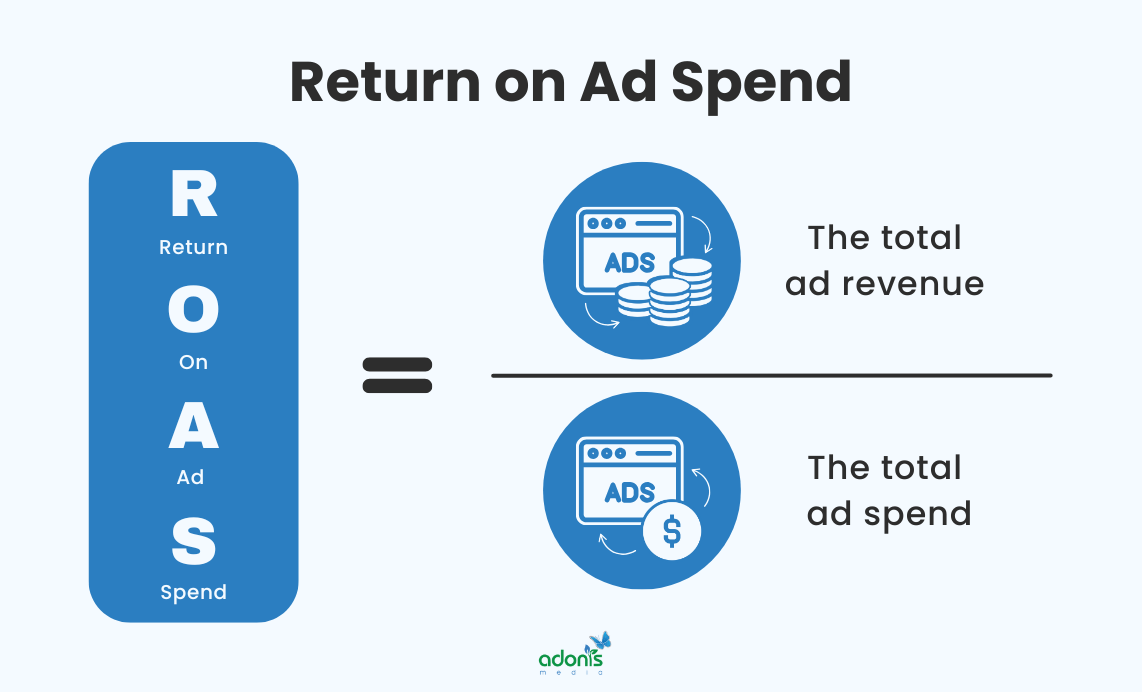
ROAS is a financial ratio that reveals how much revenue you generate for every dollar you invest in advertising. It essentially translates your ad spend into a tangible return, allowing you to assess the profitability of your advertising campaigns.
Unlike other complex marketing metrics, ROAS cuts through the noise by focusing on one simple question: are your ads making money?
When you track ROAS, you'll know immediately if your campaigns are worth the investment or if they need adjusting. It's like having a clear financial snapshot of your advertising efforts without getting tangled in complicated analytics.
Calculating your ROAS is a straightforward process. Here's the formula:
ROAS = Total Revenue Generated from Campaign / Total Ad Spend
For example:
Imagine you spend $1,000 on a Google Ads campaign and it generates $5,000 in revenue. Your ROAS would be:
ROAS = $5,000 (Revenue) / $1,000 (Ad Spend) = 5
This indicates that for every dollar you invested in the campaign, you earned $5 in revenue. Generally, a higher ROAS is considered better, but the "ideal" ROAS can vary depending on your industry, advertising goals, and profit margins.
Why Is ROAS Important?
ROAS plays a vital role in optimising your marketing budget, especially in your brand marketing plan. And knowing your ROAS helps you see if your ad spend is really paying off. It's a simple way to check if your marketing is working and worth your investment.
Measures Campaign Effectiveness
ROAS goes beyond basic click-through rates or impressions. It tells you if your ads are actually converting viewers into paying customers, making it a more valuable indicator of success.
By focusing on ROAS, you can move beyond surface-level stats and get to the heart of what matters: actual revenue. This makes it easier to spot your best-performing ads and build on what's already working for your brand.
Informs Budget Allocation
Understanding your ROAS means you can put your money where it works hardest. If one channel is giving you a better return, it really makes sense to shift more of your budget there and get more value from every pound spent.
It helps you avoid wasting money on underperforming ads. Instead, you can focus your efforts and budget on the campaigns that deliver the best results.
Improves Campaign Optimisation
Analysing ROAS helps you identify areas for improvement. For instance, if your numbers are low, it might be time to tweak your targeting or freshen up your landing page to boost results.
Regularly checking your ROAS helps you keep your campaigns at the top. It's a handy way to spot trends and make small changes that can lead to bigger profits over time.
Unlocking the Power of ROAS
Now that you grasp the basics of calculating ROAS, let's delve into the art of setting a target ROAS. This is the specific ROAS you aim to achieve for a campaign, acting as a guiding light for your advertising efforts.
Factors to Consider When Setting Your Target ROAS
- Industry Benchmarks: Research average ROAS figures for your industry to establish a baseline. Industry reports and marketing publications are great resources for this information.
- Profit Margins: Consider your profit margins. A lower profit margin might necessitate a higher ROAS to ensure profitability.
- Business Goals: Are you aiming for rapid brand awareness or maximising short-term sales? Your business goals will influence your target ROAS. For instance, a brand awareness campaign might have a lower target ROAS compared to a campaign focused on immediate conversions.
- Historical Data: Analyse your historical ROAS performance to understand past benchmarks and identify areas for improvement.
Advanced ROAS Considerations
While the core formula is simple, calculating ROAS can get more nuanced depending on your advertising strategy. Here are some additional factors to consider:
- Cost Attribution: Some advertising platforms allow you to factor in additional costs beyond just ad spend, such as landing page creation or campaign management fees. This can provide a more comprehensive picture of your return.
- Multi-Touch Attribution: Consumers often interact with your brand through multiple channels before making a purchase. Consider incorporating multi-touch attribution models to understand how different touchpoints contribute to your ROAS.
- Segmentation: Analyse ROAS for different customer segments, demographics, or ad platforms to identify areas for improvement and optimise your targeting strategies.
Strategies for Setting Realistic Target ROAS
- Start with industry benchmarks and adjust based on your specific circumstances.
- Consider the customer lifetime value (LTV). If a customer generates significant revenue over time, a lower initial ROAS might be acceptable.
- Don't be afraid to adjust your target ROAS as your campaign progresses. New data and insights can inform further optimisation.
What is a "Good" ROAS?
Unfortunately, there's no one-size-fits-all answer to this question. A "good" ROAS depends on several factors, including:
- Industry Standards: As mentioned earlier, industry benchmarks provide a starting point.
- Business Goals: A high ROAS for brand awareness might not be as crucial as a moderate ROAS for a sales-driven campaign.
- Profit Margins: A ROAS of 2 might be fantastic for a business with high margins, but unacceptable for one with lower margins.
Looking at the Bigger Picture
While ROAS is a valuable metric, it shouldn't be viewed in isolation. Here's how to gain a more holistic understanding of your campaign performance:
- Customer Acquisition Cost (CAC): Analyse your ROAS alongside your CAC. This ratio reveals how much it costs to acquire a new customer. Ideally, your ROAS should be higher than your CAC to ensure profitability.
- Conversion Rate: A low ROAS might be caused by a low conversion rate (visitors not converting to paying customers). Optimising your landing page and website can address this.
Strategies for Improving ROAS
A low ROAS indicates room for improvement. Here are some strategies to consider:
- A/B Testing: Test different versions of your ad copy, landing pages, and targeting strategies to see what resonates best with your audience.
- Refine Targeting: Ensure your ads are reaching the right audience. Utilise demographic targeting options and refine your audience criteria based on campaign data.
- Optimise Landing Pages: A well-designed landing page that aligns with your ad copy can significantly improve conversion rates and boost your ROAS.
- Lifetime Value (LTV) Considerations: ROAS typically focuses on immediate revenue generated from a campaign. However, factoring in LTV, the total revenue a customer generates over their lifetime, can provide a more long-term perspective. If a customer has a high LTV, a lower initial ROAS might be acceptable as you'll recoup costs over time.
- Contribution Margin: Understanding your contribution margin, which considers the variable costs associated with producing and selling your product, is crucial. It helps determine the minimum acceptable ROAS to ensure profitability.
Calculating Your Return on Ad Spend
Our ROAS calculator is designed for simplicity. It takes the guesswork out of measuring your ad performance, showing you exactly how much you earn for every dollar or pound spent. It's a handy way to see if your campaigns are truly paying off so you can make smarter decisions with confidence.
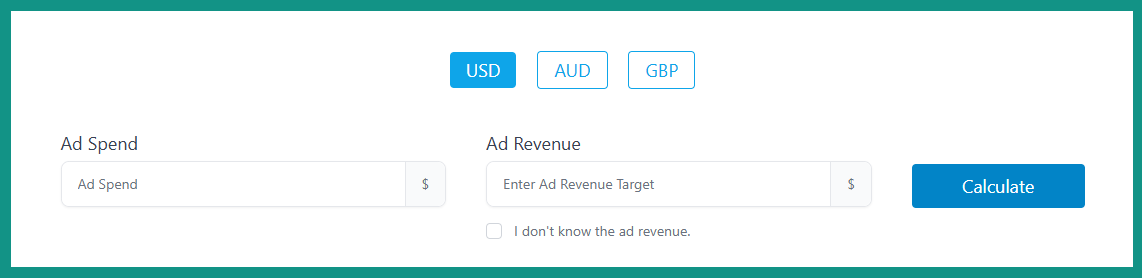
Enter the Following Information
- Ad Spend ($): The total cost you incurred for your advertising campaign, such as ad platform fees, creative development, or any additional expenses.
- Ad Revenue ($): The total revenue generated from your advertising campaign, such as sales figures, leads generated, or any other quantifiable revenue metric.
For example, it should look like this:
What You'll Get from Our Tool
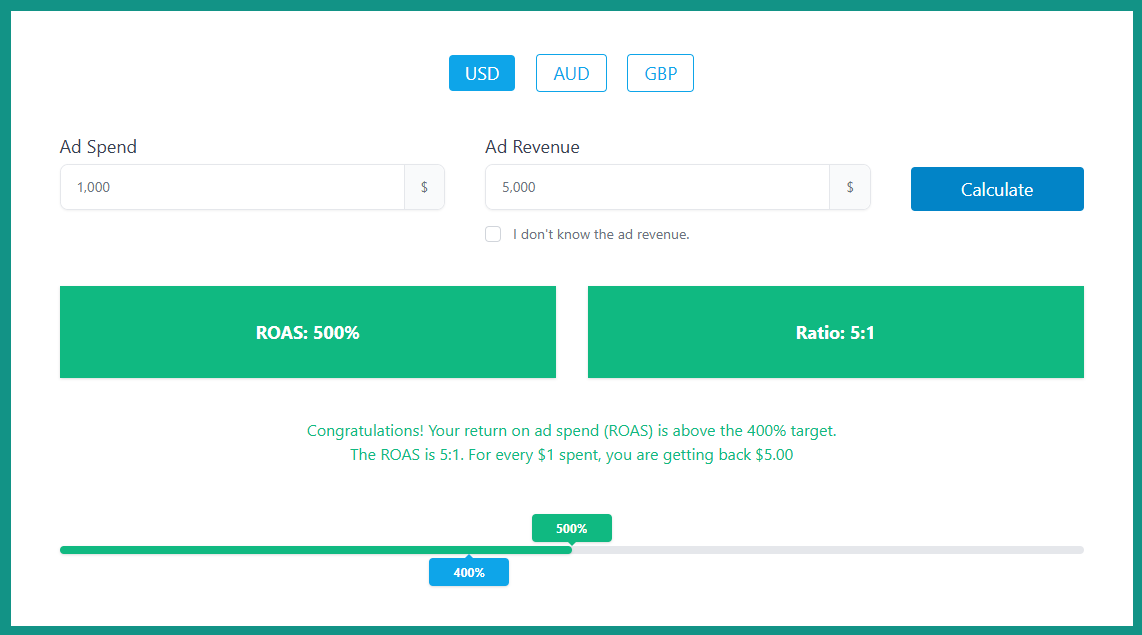
Based on the values you input, our calculator will generate the following metrics:
- ROAS (%): The percentage return you get from your ad spend. Shows how much revenue you earn for every dollar spent on ads.
- Ratio: The amount of revenue earned for each $1 spent on ads. For example, a 5:1 ratio means you get $5 back for every $1 spent.
- Result Message: A quick summary explaining your ROAS performance and what it means for your ad spend.
- ROAS Progress Bar: Shows if your ROAS meets or beats the typical benchmark (4:1).
Like this:
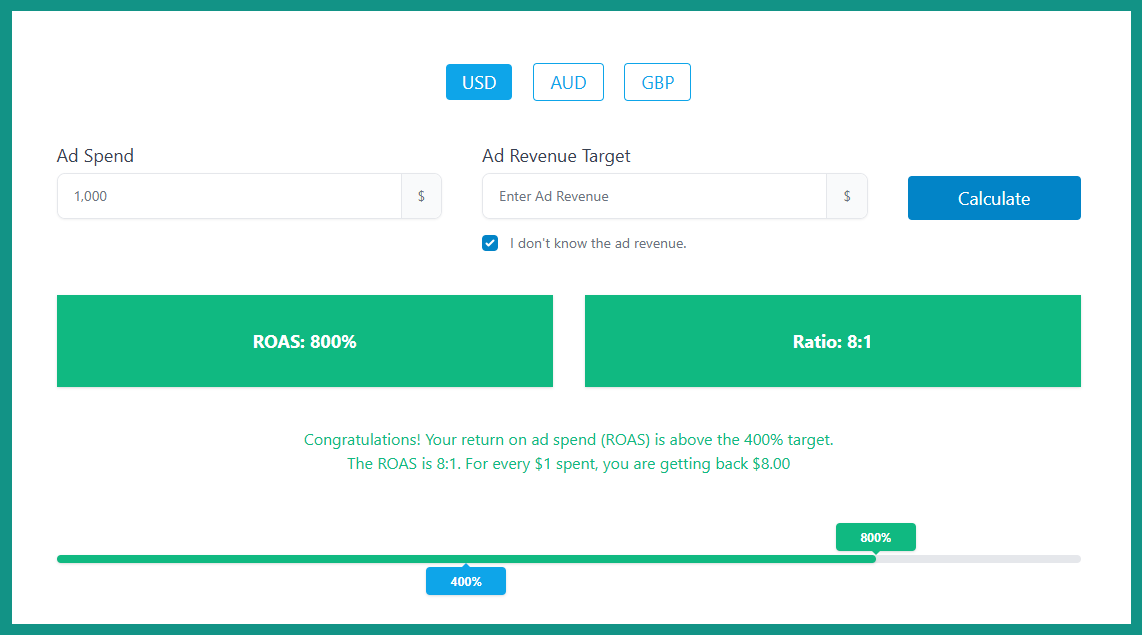
And if you're not sure about your ad revenue, simply tick the box that says, "I don't know the ad revenue." The calculator will use a typical ROAS ratio of 8:1, meaning for every $1 you spend on ads, you're getting back $8.00. This makes it easy to see your potential return, even if you don't have all the numbers on hand.
Like this:
How It Can Help Your B2B Brand
- Cut wasted ad spend. Quickly spot unprofitable campaigns and stop pouring money into ads that fail to deliver returns.
- Focus on high-return campaigns. Direct more budget toward campaigns that consistently bring in the highest revenue for your brand.
- Make data-backed decisions. Back every marketing decision with clear ROAS data instead of relying on gut feel or guesswork.
- Track impact over time. Monitoring ROAS over time can help you keep your campaigns on the right track.
The calculator provides your ROAS as a number and potentially a percentage. Remember, the number alone doesn't tell the whole story. Use the ROAS figure as a starting point for further analysis.
Unlocking Growth with ROAS
By incorporating ROAS into your marketing toolkit, you gain a valuable lens to evaluate and optimise your advertising efforts. It empowers you to make data-driven decisions, allocate your budget strategically, and ultimately achieve sustainable growth.
Our Free ROAS Calculator is your key to unlocking valuable insights and driving smarter advertising decisions. So, the next time you launch a campaign, utilise this tool to track your ROAS and propel your marketing efforts towards success!
Ready to change your marketing efforts as well? Contact us today to explore how our expertise can help you implement effective inbound marketing strategies and achieve your business goals.
Got a question in mind? Check out the FAQs below for quick answers!