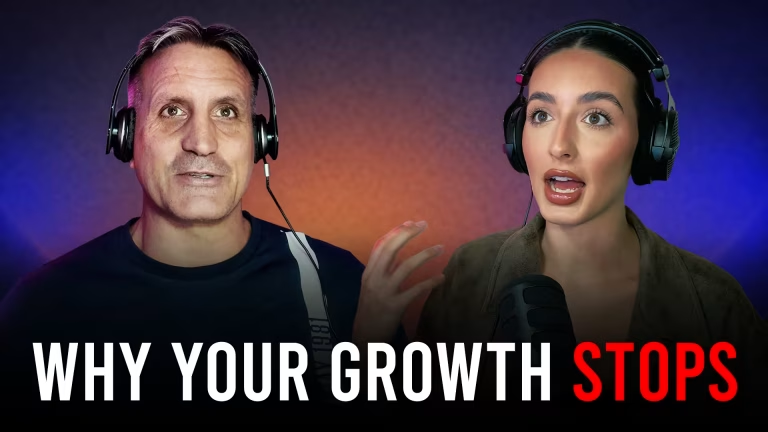





Chloe and Derek Buntin talk on the trap of chasing more leads instead of qualifying the right ones, and why 95% of your future buyers aren't in the market today.
You've generated more leads. You've got a full pipeline. Revenue's still flat - and your sales team is drowning in tyre-kickers who were never going to buy. This is what happens when businesses chase volume instead of qualification. You end up busy and broke at the same time.
Because "more leads" is the easiest number to grow yet the least useful.
The Ehrenberg-Bass Institute's research, published by LinkedIn's B2B Institute, shows that only 5% of B2B buyers are in-market at any given time. The other 95% aren't shopping for what you sell - even if you fill a database with a thousand of them and hand them to your sales team. Most sales activity in most B2B businesses is spent on the 95%. That's why the pipeline looks full and the revenue stays flat. Ten leads who are genuinely in-market convert more than a thousand who aren't. The number to grow isn't leads. It's the fit between leads and buyer readiness.
In this episode, Chloe and Derek Buntin break down the specific mistakes that turn lead gen into revenue leaks, why sales teams are being incentivised on the wrong metrics, why cold pitching without research is quietly damaging your brand, and what real account-based marketing actually looks like versus what most agencies sell as ABM. They also cover what to build instead - a single sovereign revenue system that unifies marketing, sales, customer success, and operations into one motion, so the leads that do come in actually convert.
Frequently Asked Questions
Because most of them were never in the market to buy in the first place. Research from LinkedIn's B2B Institute shows only 5% of B2B buyers are in-market at any given time. If your sales team is working through a list of a thousand leads, roughly 950 of them can't buy from you right now - regardless of how well you pitch.
The fix isn't more leads. It's better qualification of the ones you already have.
Fewer than you think, as long as they're the right ones. Ten leads who are genuinely in-market convert more revenue than a thousand who aren't. The number to grow isn't lead volume. It's the fit between the lead and your ideal customer profile, and the fit between the lead and their actual buying readiness. Both matter more than the total number.
The 95/5 rule, published by Professor John Dawes at the Ehrenberg-Bass Institute in partnership with LinkedIn's B2B Institute, states that only 5% of your potential B2B buyers are in-market at any given time. The other 95% aren't shopping for your product - but they'll be your future buyers.
Marketing to the 95% builds the mental availability that determines who they choose when they enter the market.
Usually because they're being incentivised on the wrong metric. "Make 100 calls today" is a volume KPI. It rewards activity, not conversion. Sales teams told to hit a call number will hit a call number - but the quality of those calls will collapse. Incentivise the outcome (qualified conversations, deal progression, revenue closed), not the input.
Lead gen goes wide - attract as many prospects as possible, filter for fit later.
Account-based marketing goes narrow - identify specific companies you want as clients, research them deeply, build sustained relationships with multiple stakeholders inside each one. Real ABM is a multi-month, multi-touchpoint strategy - not a cold email plus a LinkedIn connection request.
Because generic outreach from someone who hasn't researched the prospect signals that the brand doesn't care about who's on the other end. B2B buyers now spot mass-personalised outreach instantly, and once they do, trust in the brand behind it drops. If cold outreach is part of your revenue mix, it has to be genuinely researched, genuinely relevant, and part of a longer relationship-building sequence.
Look at conversion rates, not lead counts. If ad spend is producing volume but not revenue, the leak is in fit or in follow-up - not in reach. Track the whole funnel: cost per qualified lead, conversion rate to opportunity, opportunity-to-close rate, and revenue per customer. Any single metric in isolation is a vanity metric. The full sequence tells the truth.
Define your ideal customer profile before spending a dollar on ads.
Most under-performing marketing budgets fail because the brand doesn't know exactly who it's trying to reach - so the messaging tries to appeal to everyone and lands with no one.
A precise ICP, defined buyer personas, and one aligned message will outperform a bigger budget with generic targeting almost every time.
Because the founder solved the symptom, not the system that produced it. More ads fix the traffic problem for a quarter. A new agency fixes the campaign performance for six months. But the underlying problem - the fragmented marketing, sales, and operations layers not talking to each other - produces the same failure in a different form every time. Fix the system underneath. That's how the problem stops recurring.
Boderia designs and operates sovereign revenue systems for scaling B2B companies - unifying growth, operations, automation, and AI into a single governed system.
Instead of stitching together disconnected tools or hiring separate agencies for each function, clients get one platform that identifies where growth is actually leaking and rebuilds the infrastructure underneath so the same problem doesn't return.
Cookie Notice