


Podcast

Inside The Playbook of a Serial Entrepreneur & Investor | ft. John Lee

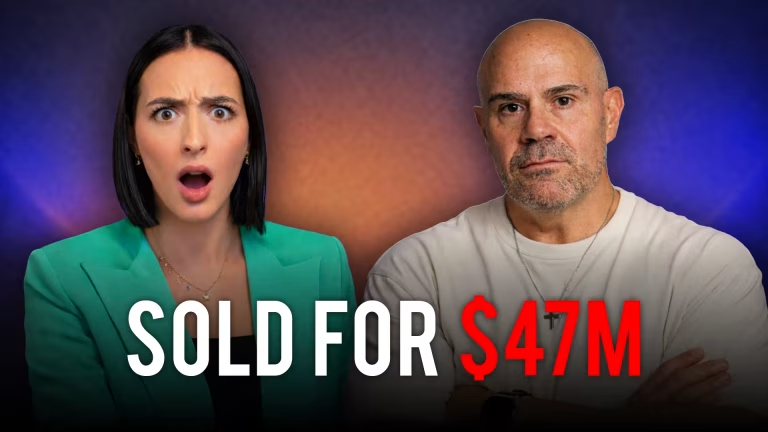
Chloe sits down with John, a serial entrepreneur across property development, drone shows, perfume vending, and film production, on the specific criteria he applies before backing any business.

Most business ideas never get funded, not because the idea was bad, but because the founder brought a pitch deck instead of proof. Investors like John hear great ideas every week. What they rarely see is evidence that real customers have tried the product, understood the interface, and been willing to pay. That gap is where most pitches die.

What Investors Are Actually Filtering For

John has funded businesses that succeeded and businesses that failed. Across all of them, the pattern that separates the two has almost nothing to do with the quality of the original idea. What matters is whether the founder has done the foundation work before asking for money.

  • Have they tested the product in the exact conditions the customer will use it in?
  • Have they watched real people interact with it without any coaching from the founder?
  • Have they refined the product until a stranger can understand it on their own?

When those three things are in place, an investor has something to back. When they are not, the pitch is asking for a leap of faith the investor has no reason to take.

What Chloe And John Cover In This Episode

Chloe sits down with John Lee to walk through what an investor actually filters for when a founder pitches. They cover the specific criteria John applies before backing a business, the mistakes he sees founders make repeatedly, and how John thinks about business partnerships and cutting ties with the wrong people. The conversation also connects to the sovereign revenue system that most businesses need once the idea is validated and the funding is in.

In This Episode, You'll Learn:

  • The specific criteria John Lee applies before backing any business
  • The mistakes he sees founders make when they pitch him, and how to avoid them
  • How to test a product before launch, so real customer behaviour matches your assumption
  • The story of John's Canungra land deal that turned $4.5 million into more than $13 million across two sales
  • How to know when your peer group or business partner is holding you back
Listen to The Adonis Effect on SpotifyListen to The Adonis Effect on Apple PodcastsWatch The Adonis Effect on YouTube

About John Jia-Ren Lee

John Lee is a serial entrepreneur based on the Gold Coast, Australia. He is the co-founder of Lee and Duce Realty Group, a property development company operating across Queensland, alongside business partner Josh Duce. He is also a partner in Sky Loom Show, one of Australia's largest private drone show providers, and Be Machine, a perfume vending business he co-founded with Edgar. His most recent venture is an executive producer credit on the upcoming film Zombie Plane, featuring Chuck Norris, Sophie Shark, and Natalie Bassingthwaighte.

John was born in Taiwan into a family that ran one of the region's largest plastic injection manufacturing businesses, producing components for McDonald's Happy Meal toys and 3M Scotch Tape. He grew up in Los Angeles from the age of twelve, studied at the University of Southern California, and moved to Australia twelve years ago.

Connect With John

You Ask, We Answer

Frequently Asked Questions

Evidence that real customers have already interacted with the product. Investors like John Lee hear great ideas every week. What they rarely see is proof that the founder has tested the concept in real conditions, watched real people use the product, and adjusted based on what actually happened rather than what they assumed would happen. Ideas by themselves have no commercial value. Proof of customer behaviour is what changes the investor conversation.

Because founders pitch the vision and skip the proof. A polished deck built on untested assumptions gives the investor nothing to back other than the founder's confidence. Investors are trained to filter for evidence, not enthusiasm, so a pitch that leads with the idea and treats customer proof as an afterthought will almost always fail. The founders who get funded almost never present the idea first. They present what real customers have already done.

By running the product through real customer interactions in the actual environment the customer will use it in. That means putting a working version in front of prospects, letting them use it without coaching, and honestly documenting what happens. Sales conversations that end in purchase count. Pilot programs count. Waitlists with real deposits count. Anecdotal customer excitement does not count as evidence, because everyone the founder speaks to is being polite.

Spend the three to six months of foundation work an investor is going to ask about. Test the product, refine the customer experience, stress-test the financial assumptions, and gather actual evidence of demand.

Founders who arrive at the pitch with this work already done get a fundamentally different conversation than founders arriving with only the concept. The pitch becomes about scaling something that works rather than validating something that might.

Look for a partner who owns hard decisions independently rather than someone who defers to you or expects you to be the deciding voice. John Lee's principle is that partnerships work best when neither party dominates and both are willing to make and stand behind hard calls.

In an investment context, a partner who cannot decide independently becomes a bottleneck the investor has to worry about, which is another reason to walk away from an otherwise attractive deal.

Depends on how much operational bandwidth is available. John Lee runs businesses across property development, drone shows, perfume vending, and film production, but each has its own operational partner running the day-to-day.

Founders without that structure are almost always better served concentrating on one business until it is genuinely stable, then diversifying from a position of strength. Investors also tend to prefer focused founders over founders spread across too many ventures.

Treat the failure as information and be transparent about it. Investors know not every business succeeds. What they filter for is whether the founder can articulate what went wrong, what they learned, and how the lesson has been applied to the next venture.

A founder who has failed cleanly and learned from it is often a better bet than a founder who has never been tested. Failure hidden or reframed damages trust. Failure discussed honestly builds it.

If sharing your ambitions consistently triggers negative reactions from your closest friends, they are probably limiting your growth. John Lee's argument is that the five people you spend the most time with set the ceiling on what you consider possible.

Peer groups that treat your ambition as a personal criticism of theirs, or that consistently steer you toward smaller ideas, are quietly compressing what you will attempt. The fix is uncomfortable but necessary.

The investment gets the business into the market. Everything after that depends on the operational infrastructure underneath. Businesses that scale after funding almost always have a governed system in place from day one, where every part of the business feeds into the same source of truth. Businesses that skip that layer end up spending the investment on fragmented tools, disconnected teams, and firefighting when the growth outstrips what the operations can hold.

Boderia designs and operates sovereign revenue systems for scaling B2B companies - unifying growth, operations, automation, and AI into a single governed system.

Instead of stitching together disconnected tools or hiring separate agencies for each function, clients get one platform that identifies where growth is actually leaking and rebuilds the infrastructure underneath so the same problem doesn't return.

Related Articles

Continue reading with more articles on this topic.

Cookie Notice

This website uses cookies to ensure you get the best experience on our website.
Privacy Policy